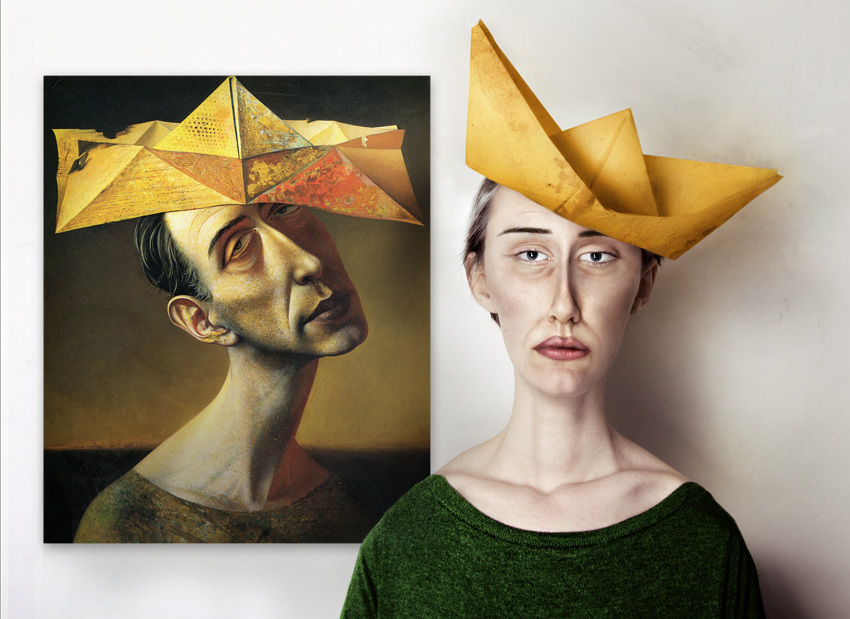
The Real Life Models by Flora Borsi
Flora Borsi’s The Real Life Models sits at an intersection where art history, digital manipulation, and psychological curiosity quietly overlap. The series does not aim to shock through excess or distortion. Instead, it unsettles by asking a deceptively simple question about how images are made, and what we accept as real once they are presented to us.
Borsi explores the long-standing relationship between painters and their subjects, particularly the use of models as anatomical reference points. For centuries, artists have relied on real bodies to construct imagined worlds. Even the most abstract or surreal paintings often begin with something observed, something human. In The Real Life Models, Borsi reverses that process. Rather than using people to build imaginary figures, she imagines what it would look like if those abstract figures stepped into reality.
The result is deliberately eerie. Faces appear altered yet grounded, familiar yet incorrect. Proportions feel just slightly off. Expressions hover between neutral and uncanny. The images resist immediate understanding, which is precisely what gives them their power. They occupy a space where recognition and discomfort coexist.
Borsi’s use of digital tools is central to the work, but never the focus. She treats editing software not as a shortcut, but as an extension of traditional artistic methods. As she notes, contemporary photographers often use graphics software in the same way painters once relied on original references and underdrawings. The technology may change, but the impulse remains the same.
There is also a quiet commentary on authorship and authenticity running through the series. In an era where heavily manipulated images are the norm, The Real Life Models questions why some alterations feel acceptable while others provoke unease. The figures in Borsi’s work are clearly constructed, yet they maintain a sense of presence that feels uncomfortably human.
What makes the series compelling is its restraint. The images do not explain themselves. They do not offer narrative closure or emotional resolution. Instead, they invite prolonged looking. The longer one studies them, the more the boundary between reference and invention begins to blur.
The Real Life Models is less about technique and more about perception. It asks viewers to consider how much of what they see in art is imagined, how much is observed, and where the line between the two truly exists. Borsi does not provide answers. She leaves the question open, suspended somewhere between painting, photography, and reality itself.
Credit:
Artist: Flora Borsi
“What if these abstract models were real people?” – Flora Borsi